
Kosher Astrology: A Jewish Guide to Celestial Wisdom (Mosaica Press, 2024), by Yitzchok Aharon Pinkesz — This controversial work argues that a Torah-based form of astrology is part of the Jewish tradition and can serve as a tool for self-understanding, spiritual growth, and discerning one’s life purpose. He contrasts his "kosher" astrology with astral magic and the sort of fatalistic/deterministic engagement in astrology decried by great rabbis like Maimonides. Despite making a case for Torah-based astrology, the exact details of the astrology that Pinkesz presents largely reflects modern, non-Jewish astrology rather than an authentic tradition of Chazal.

Talmud Chronicles: Bringing Talmudic Events to Life (Urim Publications, 2026), by Zalman Eisenstock —This cute book is presented in the format of a modern daily newspaper reporting on the events that occurred in Tannaic times as depicted in Chazal. It has all the trappings of a real newspaper, like world news, interviews, cartoons, features, and advertisements. It is all done as an informative and friendly edutainment-style introduction to the rabbis and their intellectual world.

The Sevoraic Period and its Literature: In Babylonia and in Eretz Israel (Petach Tikva, Israel: Agudath Bnai Asher, 1973), by Jacob E. Ephrathi —This Hebrew book offers a glimpse at a little-known station in Jewish History nestled between the Amoraic Period and the Geonic Period. Its heroes are the Rabbanan Saborai who are understood to have edited and finalized the Babylonian Talmud as we know it. This book explains what political changes led to the close of the Amoraic period in Babylon and Palestine, and offers a close examination of several Talmudic pericopes that are traditionally ascribed to the Saboraim.

Divrei Soferim: The Transmission of the Torah Shebe’al Peh (Maggid Books, 2024), by Rabbi Hershel Schachter — This English work written by one of the contemporary Gedolim explores how the Oral Torah was transmitted, preserved, interpreted, and developed across the generations, focusing on the role of Chazal and the rabbinic tradition in safeguarding and communicating Torah knowledge. It offers a wide-ranging study of such topics as the interplay between rabbinic and Biblical law, how drashot work, and the significance of the "sealing" of the Talmud.
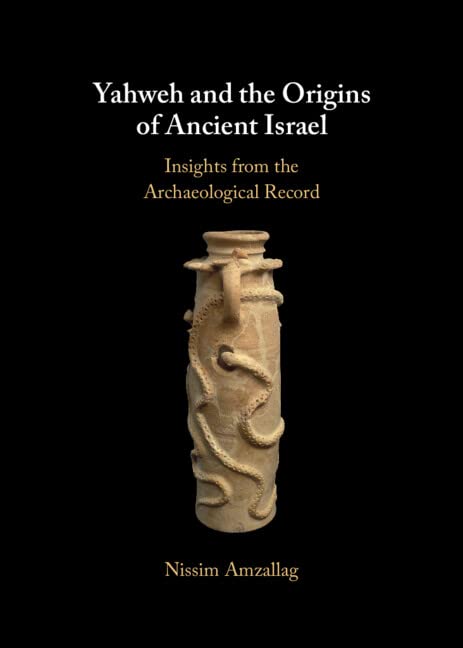
Yahweh and the Origins of Ancient Israel: Insights from the Archaeological Record (Cambridge University Press, 2023), by Nissim Amzallag — An interesting work of Biblical scholarship that argues that YHWH originated as a deity with metallurgical/volcanic connections. This deity was instrumental in the emergence of the Israelites as a separate nation when they rebelled against the ruling Amorites. The book has an original, eclectic methodology that is neither purely academic nor does it line up with any traditional Jewish interpretations.

Yahweh Among the Gods: The Divine in Genesis, Exodus, and the Ancient Near East (Cambridge University Press, 2022), by Michael Hundley — This book examines the biblical conception of God against the wider polytheistic world of the ancient Near East, comparing the divine beings described in the literatures associated with Mesopotamia, Egypt, Canaan, and the Hittites with the realities expressed in the Bible. From a traditional Jewish perspective, the book is particularly useful for illustrating the profound distinction between the Torah’s uncompromising insistence that Hashem alone is to be worshipped with trends in other neighboring societies. Hundley interprets this disconnect in terms of a hypothesized evolution with ancient Israelite monolatry progressing toward later monotheism.

The Secret Doctrine of the Jews: Jewish Theosophists and the Kabbalah (SUNY Press, 2025), by Boaz Huss — This scholarly work details the history of Jewish participation in the Theosophical Society, an influential esoteric movement founded in New York in 1875 to promote “universal brotherhood” and a claimed ancient, universal wisdom tradition. The book fascinatingly traces Jewish members and lodges across Europe, America, the Middle East, India, and pre-State Israel, showing how they negotiated tensions between Jewish particularity and Theosophy’s universalism, while also confronting antisemitic assumptions within the movement. These Jews used Theosophy to reinterpret and disseminate Kabbalah in modern, universalist terms, which arguably shaped later academic understandings of Kabbalah. Its copious endnotes are a great resource for those interested in knowing more.

The Exile of Language: German-Jewish Philosophical Challenges of Linguistic Autochthony (Brill, 2025), by Libera Pisano — This book examines five early-twentieth-century German-Jewish thinkers (Fritz Mauthner, Gustav Landauer, Margarete Susman, Franz Rosenzweig, and Walter Benjamin) who responded to the modern “crisis of language” by questioning the supposedly natural connection between language, identity, nation, territory, and historical belonging. From a traditional Jewish perspective, the book is especially interesting as a portrait of a largely secularized Jewish intellectual world rediscovering themes that have deep Jewish resonance (like exile, the sanctity of language, linguistic instability, and utility of translation).

Miracles of the Beis Hamikdash (Mosaica Press, 2026), by Rabbi Yehoshua Dovid Portowicz — This 450+ page book is written by Rosh Kollel who is an expert in the Holy Temple and the avodah performed therein. This substantial study of the many miraculous phenomena associated with the Temple presents those miracles in a detailed and accessible way, while also pointing out practical lessons we can learn from those occurrences.

The Jew who would be King: A True Story of Shipwreck, Survival, and Scandal in Victorian Africa (University of California Press, 2025), by Adam Rovner — This book is a reconstruction of the life story of an Anglo-Jewish adventurer named Nathaniel Isaacs who carved out a small kingdom for himself in Africa. It is an intriguing tale with lots of unexpected twists. Although it reads like a novel, this book is actually a scholarly reconstruction of Isaacs's life based on archival research and other contemporaneous sources. Indeed, the detailed endnotes attest to the scholarly nature of this work.

Splitting Hairs: The History, Law, and Future of Jewish Laws of Modesty and Women’s Head Covering (Ben Yehuda Press, 2026), by Michael J. Broyde — This nearly 500-page book is the culmination of many years of Rabbi Dr. Broyde's studies on the topic of women's hair covering in Halachah. He contends that the Halachic requirement of a married women covering her hair primarily stems from a general requirement that women dress modestly according to the norms of their surrounding society (rather than according to one universal, unchanging code). He thus argues that in times and places where even modest women do not cover their hair, this requirement is a mere chumra. In this book, Broyde reproduces many primary sources in Halachah, bringing to the reader the Hebrew texts and their English translations so they can judge for themselves.
