11 Books I read in 2026


Kosher Astrology: A Jewish Guide to Celestial Wisdom (Mosaica Press, 2024), by Yitzchok Aharon Pinkesz — This controversial work argues that a Torah-based form of astrology is part of the Jewish tradition and can serve as a tool for self-understanding, spiritual growth, and discerning one’s life purpose. He contrasts his "kosher" astrology with astral magic and the sort of fatalistic/deterministic engagement in astrology decried by great rabbis like Maimonides. Despite making a case for Torah-based astrology, the exact details of the astrology that Pinkesz presents largely reflects modern, non-Jewish astrology rather than an authentic tradition of Chazal.

Talmud Chronicles: Bringing Talmudic Events to Life (Urim Publications, 2026), by Zalman Eisenstock —This cute book is presented in the format of a modern daily newspaper reporting on the events that occurred in Tannaic times as depicted in Chazal. It has all the trappings of a real newspaper, like world news, interviews, cartoons, features, and advertisements. It is all done as an informative and friendly edutainment-style introduction to the rabbis and their intellectual world.

The Sevoraic Period and its Literature: In Babylonia and in Eretz Israel (Petach Tikva, Israel: Agudath Bnai Asher, 1973), by Jacob E. Ephrathi —This Hebrew book offers a glimpse at a little-known station in Jewish History nestled between the Amoraic Period and the Geonic Period. Its heroes are the Rabbanan Saborai who are understood to have edited and finalized the Babylonian Talmud as we know it. This book explains what political changes led to the close of the Amoraic period in Babylon and Palestine, and offers a close examination of several Talmudic pericopes that are traditionally ascribed to the Saboraim.

Divrei Soferim: The Transmission of the Torah Shebe’al Peh (Maggid Books, 2024), by Rabbi Hershel Schachter — This English work written by one of the contemporary Gedolim explores how the Oral Torah was transmitted, preserved, interpreted, and developed across the generations, focusing on the role of Chazal and the rabbinic tradition in safeguarding and communicating Torah knowledge. It offers a wide-ranging study of such topics as the interplay between rabbinic and Biblical law, how drashot work, and the significance of the "sealing" of the Talmud.
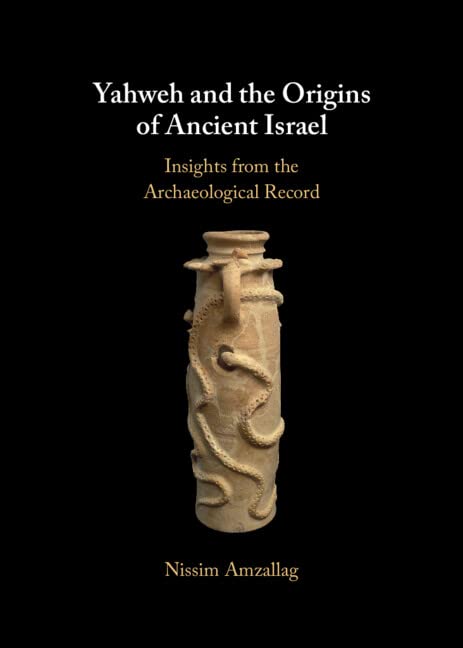
Yahweh and the Origins of Ancient Israel: Insights from the Archaeological Record (Cambridge University Press, 2023), by Nissim Amzallag — An interesting work of Biblical scholarship that argues that YHWH originated as a deity with metallurgical/volcanic connections. This deity was instrumental in the emergence of the Israelites as a separate nation when they rebelled against the ruling Amorites. The book has an original, eclectic methodology that is neither purely academic nor does it line up with any traditional Jewish interpretations.

Yahweh Among the Gods: The Divine in Genesis, Exodus, and the Ancient Near East (Cambridge University Press, 2022), by Michael Hundley — This book examines the biblical conception of God against the wider polytheistic world of the ancient Near East, comparing the divine beings described in the literatures associated with Mesopotamia, Egypt, Canaan, and the Hittites with the realities expressed in the Bible. From a traditional Jewish perspective, the book is particularly useful for illustrating the profound distinction between the Torah’s uncompromising insistence that Hashem alone is to be worshipped with trends in other neighboring societies. Hundley interprets this disconnect in terms of a hypothesized evolution with ancient Israelite monolatry progressing toward later monotheism.

The Secret Doctrine of the Jews: Jewish Theosophists and the Kabbalah (SUNY Press, 2025), by Boaz Huss — This scholarly work details the history of Jewish participation in the Theosophical Society, an influential esoteric movement founded in New York in 1875 to promote “universal brotherhood” and a claimed ancient, universal wisdom tradition. The book fascinatingly traces Jewish members and lodges across Europe, America, the Middle East, India, and pre-State Israel, showing how they negotiated tensions between Jewish particularity and Theosophy’s universalism, while also confronting antisemitic assumptions within the movement. These Jews used Theosophy to reinterpret and disseminate Kabbalah in modern, universalist terms, which arguably shaped later academic understandings of Kabbalah. Its copious endnotes are a great resource for those interested in knowing more.

The Exile of Language: German-Jewish Philosophical Challenges of Linguistic Autochthony (Brill, 2025), by Libera Pisano — This book examines five early-twentieth-century German-Jewish thinkers (Fritz Mauthner, Gustav Landauer, Margarete Susman, Franz Rosenzweig, and Walter Benjamin) who responded to the modern “crisis of language” by questioning the supposedly natural connection between language, identity, nation, territory, and historical belonging. From a traditional Jewish perspective, the book is especially interesting as a portrait of a largely secularized Jewish intellectual world rediscovering themes that have deep Jewish resonance (like exile, the sanctity of language, linguistic instability, and utility of translation).

Miracles of the Beis Hamikdash (Mosaica Press, 2026), by Rabbi Yehoshua Dovid Portowicz — This 450+ page book is written by Rosh Kollel who is an expert in the Holy Temple and the avodah performed therein. This substantial study of the many miraculous phenomena associated with the Temple presents those miracles in a detailed and accessible way, while also pointing out practical lessons we can learn from those occurrences.

The Jew who would be King: A True Story of Shipwreck, Survival, and Scandal in Victorian Africa (University of California Press, 2025), by Adam Rovner — This book is a reconstruction of the life story of an Anglo-Jewish adventurer named Nathaniel Isaacs who carved out a small kingdom for himself in Africa. It is an intriguing tale with lots of unexpected twists. Although it reads like a novel, this book is actually a scholarly reconstruction of Isaacs's life based on archival research and other contemporaneous sources. Indeed, the detailed endnotes attest to the scholarly nature of this work.

Splitting Hairs: The History, Law, and Future of Jewish Laws of Modesty and Women’s Head Covering (Ben Yehuda Press, 2026), by Michael J. Broyde — This nearly 500-page book is the culmination of many years of Rabbi Dr. Broyde's studies on the topic of women's hair covering in Halachah. He contends that the Halachic requirement of a married women covering her hair primarily stems from a general requirement that women dress modestly according to the norms of their surrounding society (rather than according to one universal, unchanging code). He thus argues that in times and places where even modest women do not cover their hair, this requirement is a mere chumra. In this book, Broyde reproduces many primary sources in Halachah, bringing to the reader the Hebrew texts and their English translations so they can judge for themselves.

The Lost Novel of King Solomon and the Demons

The Lost Novel of King Solomon and the Demons (Mohr Siebeck, 2025), by Ittai Gradel & Nils Arne Pedersen

Reviewed by Rabbi Reuven Chaim Klein

On the Holiday of Sukkot, Jews around the world read Kohelet — Ecclesiastes — and encounter one of its opening verses: “I, Kohelet, was king over Israel in Jerusalem” (1:12). The past tense was has long troubled readers. Why does King Solomon, the wisest and most powerful king Israel ever knew, speak of his kingship in the past tense?

The Talmud provides a startling answer. In Gittin 68a–b, we learn that Solomon’s dominion over the spirit world — his ability to command demons with a ring bearing God’s name — ultimately led to his undoing. The demon-king Ashmedai, whom Solomon had captured and forced to help build the Temple, tricked the king into removing his protective ring. Ashmedai swallowed it, hurled Solomon 400 parasangs from Jerusalem, and took his throne. Solomon wandered as a beggar, repeating to anyone who would listen: “I, Kohelet, was king over Israel in Jerusalem”. No one believed him.

This extraordinary tale is part of a rich ancient tradition in which Solomon is not merely a wise king, but a master of demons. Josephus (writing in the first century ce), already knew Solomon as the author of exorcistic incantations and described a Jewish exorcist named Eleazar who expelled demons “in Solomon’s name” before the Roman emperor Vespasian. Likewise, one of the Dead Sea Scrolls (11Q11 also known as "11QApocryphal Psalms") associates Solomon with exorcistic psalms. And, most importantly for this book review, the book Testament of Solomon, a fascinating and deeply strange pseudepigraphical work, portrays Solomon as the supreme demon-controller, using a divine ring to command an entire hierarchy of spirits.

The book under review is a scholarly study of the Testament of Solomon (abbreviated as TSol). For generations, scholars have debated the origins of this work. Is it Jewish, Christian, or something in between? When was it written? And what does it tell us about the ancient world’s fascination with Solomon’s supernatural powers? Ittai Gradel and Nils Arne Pedersen’s study offers learned answers to some of those questions and essentially promises to rewrite the history of one of antiquity’s most mysterious texts.

The Testament of Solomon is preserved in about 26 Greek manuscripts, the earliest dating to the Middle Ages. First published in 1837, this work tells the story of Solomon building the Temple when a demon named Ornias begins tormenting one of his workmen. Solomon prays for help, and the archangel Michael brings him a ring with a magical seal. With this ring, Solomon commands demons — Beelzeboul, Asmodeus (Ashmedai), Onoskelis, and dozens more — to appear before him, confess their names and powers, and labor on the Temple. The work is part narrative, part demonological encyclopedia (in this way, much of the book is a catalog of names of demons and the ways their malevolent effects can be avoided).

But the Testament of Solomon is deeply puzzling. It shifts between first-person and third-person narration. And it contains material that feels Jewish, alongside material that are decidedly Christian (references to “the Son of God,” "Emmanuel," and Christological exorcism) and pagan (astrological decans and Greek-style demons). Scholars have long debated whether it is a Jewish work with Christian interpolations, a Christian recension of a Jewish original, or a fundamentally Christian composition.

Gradel and Pedersen’s contribution begins not with manuscripts, but with archaeology. The starting point of their investigation is a group of ten bronze rings from the third century ce, each inscribed in Greek with the same phrase: "Solomon says: ‘Watch out!’”

The phrase is puzzling. Why would an amuletic ring bear a command to “watch out”? The authors argue that this ring-inscription makes sense only in light of the Testament of Solomon. In a climactic episode in that work, Solomon orders two demons to support a massive pillar — and he commands them with precisely these words: “Watch out!” (TSol 24:2). The rings, then, are apotropaic amulets: their wearers were invoking Solomon’s power to bind demons, quoting a scene from the story told in the Testament of Solomon.

Six of the rings are nearly identical, suggesting they came from a single workshop. Two bear Christian symbols — one with two fish, another with a fish-and-anchor motif — pointing to a Christian milieu. One ring has been linked to the Christian pilgrimage site of Abu Mena in Egypt.

From this archaeological evidence, Gradel and Pedersen develop a bold thesis: They argue that the rings establish that the original version of the Solomon-demon narrative predates the third century — possibly by a considerable margin. Moreover, the rings refer to Solomon in the third person (“Solomon says”), not the first person ("I say"). This suggests that the earliest form of the Testament of Solomon was not a first-person “testament” at all, but rather a third-person narrative — a novel, in effect.

Further evidence in this direction is harnessed by what the authors consider TSol's abrupt, hurried ending, which points to the hand of an editor who changed the book around to make it fit the testament genre. That awkward conclusion relates that King Solomon crushed grasshoppers as an act of idolatry to please a Jebusite woman whom he wanted to wed, and with that sinful act, he quickly loses all his powers.

Building on this, the authors posit and attempt to reconstruct what they refer to as the lost Proto-TSol: a longer, more coherent third-person account of King Solomon and the demons. They argue that a later editor (whom they call the “testamentary redactor”) abridged this novel and reframed it as Solomon’s own first-person testament, the version preserved in the Greek manuscripts. This explains the work’s awkward shifts in person and tense: the editor was sloppily imposing the testament genre onto a pre-existing narrative.

Several pieces of evidence are adduced to support this reconstruction. Later manuscripts have the verb in the plural in Solomon’s command to the demons, “Watch out!”— after all, there are two demons. The oldest manuscript, designated G (dated to 1332 CE), has the verb in the singular, exactly as on the rings. The authors also identify certain passages — the list of thirty-six spirits (TSol 18) and the Enepsigos episode (TSol 15:8–12) — as later interpolations, likely added in the fourth or fifth century. There are other technical complicated philological/linguistic arguments to support the authors' novel theory.

But perhaps most intriguingly, a Syriac Christian text, the Obsequies of the Virgin (6th century), contains a story essentially identical to TSol 20, but told entirely in the third person. This, Gradel and Pedersen argue, preserves Proto-TSol’s original phrasing and demonstrates that the original third-person Solomonic narrative still circulated in Christian circles as late as the sixth century.

The book’s most controversial claim concerns the religious identity of Proto-TSol. Gradel and Pedersen argue that it was an originally Christian work, not a Jewish work with Christian additions. The evidence? The Christian iconography on several rings, the reference to “the Son of God” in the text, and the Alexandrian context suggested by the Abu Mena connection. In fact, the authors propose Alexandria (or its environs) as the birthplace of the tradition.

Indeed, the authors surmise that Proto-TSol first emerged among Christians in Alexandria, but early Church fathers were uncomfortable with the popular acceptance of this non-biblical work and were especially wary of its discussions of demons and the like. This provides the motive for the redactor to rework Proto-TSol into a testament-style book, as though it were written by Solomon himself, in order to make the work more palatable to those who objected.

But is this conclusive? The rings with Christian symbols represent only two of the ten. Magic culture in late antiquity was notoriously syncretistic, cutting across religious boundaries. The Aramaic incantation bowls, for example, show Jewish, Christian, and pagan magical formulae circulating side by side, often indistinguishable in their linguistic and ritual forms. A ring quoting “Solomon says: 'Watch out!'” might have been used by Christians, Jews, or pagans alike — the words themselves don’t determine the religion of the text they quote. In the ancient world, "magicians" operated on the fringes of society, and this book's close association with the world of magic would suggest that it anyways does not belong not to any specific mainstream religious community, but to the cast-offs from those communities.

Even after the authors trace Proto-TSol to second-century Alexandria, this does not rule out a Jewish author. This is because the Jewish community of Alexandria, though devastated by Trajan’s repression in the early second century, maintained a presence until the 400s, when Cyril of Alexandria finally expelled them. So even if we accept that the book was written in Alexandria, it does not follow that it emerged from the hand of a Christian writer.

And what of the rabbinic parallels? The Talmudic story of Solomon and Ashmedai shares remarkable motifs with the Testament of Solomon: a divine ring, demonic captivity, and forced participation in constructed the Jerusalem Temple. Yet although Gradel and Pedersen recognize these parallels, they effectively “minimize” them in favor of their Christian-composition thesis. In other words, they never seriously entertained the possibility of a Jewish origin for Proto-TSol. Some scholars might see this as a weakness.

Another possibility: Could Proto-TSol have emerged from a Judeo-Christian milieu — a world before the “parting of the ways,” where Jewish and Christian traditions intermingled freely? That option, which feels increasingly plausible to some scholars of late antiquity, receives less in attention in this book than it might deserve.

For long-time readers of the Jewish Press, the legends of King Solomon and the demons may recall the now-defunct comics section of the newspaper, where these tales once entertained children like myself. But Gradel and Pedersen remind us that these are not mere Medieval fantasies. They are part of an ancient, international tradition — a tradition that crossed from Jewish Palestine to Christian Alexandria to Sassanian Babylonia, taking new forms in each context.

The Lost Novel of King Solomon and the Demons may not have the last word on the Testament of Solomon. But it has revived interest in one of the most mysterious of ancient pseudepigrapha, and its ring evidence gives us something no amount of manuscript study could provide: physical proof that real people in the third century wore King Solomon’s supposed words on their fingers, hoping to ward off the demons that plagued their world. Those rings were brought into the discussion by co-author Ittai Gradel (a British-Danish academic and antiquities dealer who was born in Haifa), who passed away shortly after the book’s publication. This volume represents the culmination of his scholarly work — a bold, interdisciplinary synthesis that will surely provoke debate for years to come.

The reader should know ahead of time that the full text of some versions of TSol appear in the book's appendices. This reviewer actually recommends reading the appendices first before digging into the book's nitty gritty philological discussions. Also, knowing how to read Greek would be helpful for some of the more technical arguments in the book (especially the footnotes), but is not absolutely necessary to understand the main points. In fact, even though this is a scholarly book published by an academic press, it is still interesting to a broader lay audience (like myself).

As we read Kohelet over Sukkot — “I was king over Israel in Jerusalem” — we might remember that Solomon’s story, in all its strange and wonderful variations, is still being discussed and debated to this very day.


Renewing the Old, Sanctifying the New: The Unique Vision of Rav Kook


Renewing the Old, Sanctifying the New: The Unique Vision of Rav Kook (The Littman Library of Jewish Civilization, 2025), by Marc B. Shapiro 

Reviewed by Rabbi Reuven Chaim Klein

Professor Marc B. Shapiro’s Renewing the Old, Sanctifying the New: The Unique Vision of Rav Kook is not the intellectual biography that some readers may expect. Those who approach it hoping for a companion to Yehudah Mirsky’s Rav Kook: Mystic in a Time of Revolution will instead find a different kind of study: an episodic, source-driven examination of recently published manuscript material, largely from the Shemonah Kevatzim and related notebooks, in which Rav Kook’s more radical, unpolished, and at times somewhat unsettling reflections are brought to light. Shapiro’s aim is both archival and constructive — to recover what has been omitted from the standard, sanitized Rav Kook corpus and to argue that these private notebooks expand, rather than distort, our understanding of one of modern Orthodoxy’s most complex thinkers.

Shapiro organizes the book into nine substantive chapters, each of which treats a distinct conceptual terrain. He devotes sustained attention to Rav Kook’s understanding of halakhah, especially the claim that the commandments are not uniformly beneficial for every individual and that excessive absorption in halakhic detail can diminish spiritual stature. This is connected to what Shapiro calls the “valorization of the masses”: Rav Kook’s conviction that the simple, unlearned Jew often preserves a purer natural morality (mussar tiv‘i) than the learned scholar, whose instincts may be distorted by legal and intellectual abstraction. Shapiro traces the halakhic implications of this view: a future Sanhedrin, in Kook’s vision, could rederive derashot, alter positive commandments, and even authorize women to testify in rabbinic courts — not as a modernizing capitulation, but as a legitimate theological mechanism for encoding moral progress into Torah Law.

A second cluster of themes concerns knowledge, science, and Biblical interpretation. Shapiro presents Rav Kook as holding that the Torah’s purpose is theological and moral rather than scientific or historical. Accordingly, the Six Days of Creation need not be read as literal twenty-four-hour periods, early Genesis narratives may be allegorical, and the story of Cain and Abel may be a moral paradigm rather than a historical report. In these sections, Rav Kook emerges as a thinker who regarded broad engagement with philosophy and the sciences as a religious necessity, warning that a narrow curriculum produces stringency born of ignorance and even diminishes the Divine image in those who refuse to study what their mental capacities allow.

Dr. Shapiro also foregrounds the redefinition of heresy. Rav Kook distinguishes between intellectual doubt and deliberate rejection, creating space for the “unintentional heretic” whose loss of belief is the product of inadequate formulations rather than malice (pace Rav Chaim Brisker). This pastoral leniency is complemented by a strikingly positive theology of other religions: Shapiro marshals passages in which Rav Kook entertains the possibility that Christianity and Islam contain genuine divine significance (taking Maimonides' famous comments about this to the nth level), that their founders may have been divinely assisted, and that righteous non-Jews need not abandon their inherited monotheistic traditions. Finally, the book’s closing chapter examines the eschatological status of animal sacrifice. Here, Rav Kook’s writings are internally tense: he can defend sacrifices as pedagogically appropriate (like Maimonides does in his Guide for the Perplexed), yet also envisions a Messianic future in which animal offerings are abolished and only vegetable offerings remain.

Marc B. Shapiro’s scholarly virtues are evident throughout. He treats the newly-available notebooks with philological care, situates individual passages within broader Kookian debates, and draws on earlier scholarship without simply repeating it. His comparative approach —sometimes bringing voices that agree, sometimes voices that disagree, sometimes setting Rav Kook against himself — is useful because it resists the reduction of these notebooks to a single coherent doctrine. Shapiro's study is a valuable resource for advanced students of modern Jewish thought and for anyone concerned with the relationship between halakhah, morality, and modernity.

Yet, the book also invites a more cautious response. Its architecture is closer to a collection of annotated excerpts and thematic reactions than to a systematic exposition, and readers seeking a unified intellectual portrait of Rav Kook may find the result episodic. More substantively, the very materials on which Shapiro relies raise a hermeneutical problem that the book acknowledges but does not fully resolve. Private notebooks are not finished works; they contain tentative formulations, contradictions, and experimental lines of thought. Some of the passages that Shapiro presents (such as the suggestion that mitzvot may be damaging to certain righteous individuals, or that the founders of Christianity and Islam may have been divinely inspired) read less like settled theological positions than like unguarded jottings or musings. One can appreciate Shapiro’s archival honesty while wondering whether their publication serves Rav Kook’s intellectual legacy or, as some traditional readers will conclude, detracts from it.

From a more Ultra-Orthodox perspective, these texts provide grist for the long-standing suspicion that Rav Kook was — God forbid — some sort of deviant or even antinomian figure. Within some Religious Zionist circles, the opposite danger arises: a kind of Dati Leumi daas Torah that accepts any statement simply because it bears Rav Kook’s name. Shapiro is aware of both dangers, but his own interpretive default is often to maximize the radicalism of a passage, rather than to quarantine it as an undeveloped thought.

At times, the book reads as a charitable attempt to make sense of material that may not have been intended for such close analysis. One might even raise the possibility, however diplomatically, that the sheer volume of Rav Kook’s writing — much of it unpublished and unedited — means that not every line can bear the weight of theological scrutiny. In other words, the possibility that Rav Kook’s nearly graphomaniacal output included thoughts that were never meant to be doctrinal is not seriously entertained. In fact, Shapiro’s project implicitly rejects that possibility, treating the notebooks as "revelatory" of Rav Kook’s true thought, but the evidence does not always force that conclusion.

All this makes Renewing the Old, Sanctifying the New a fascinating curiosity, rather than a definitive interpretation. It is not the place to begin for a balanced introduction to Rav Kook, nor does it settle the question of which Rav Kook — mystic theologian or restless experimenter —should command authority. But it will certainly pique the interest of anyone interested in Rav Kook’s thought. Ultimately, as Shapiro wrote in his conclusion, we can just take from Rav Kook's writings whatever resonates with us and reject what clashes with our sensibilities. Shapiro has performed an important scholarly service by bringing difficult, inaccessible, and often deliberately suppressed texts into the light, and he has done so with erudition, candor, and a willingness to let Rav Kook be as uncomfortable as he actually was. For that reason, despite its unresolved problems, the book deserves a place alongside the best recent work on modern Jewish thought.

The Making of an Anglo-Jewish Scholar: The Unconventional Life and Thought of Solomon Yom Tov Bennett (1767-1838)

The Making of an Anglo-JewishScholar: The Unconventional Life and Thought of Solomon Yom Tov Bennett(1767-1838), by David B. Ruderman (De Gruyter, 2024)

Reviewed by Rabbi Reuven Chaim Klein (Rachack Review)

David B. Ruderman’s compact biography of Solomon Yom Tov Bennett rescues an odd, compelling figure from the footnotes of Anglo-Jewish history and serves up a life that is as instructive as it is uncomfortable. If your interest is in Jewish tradition — its texts, its institutions, and the social pressures that shape how Jews live with their texts — this little book will give you everything you want: vivid episodes, plenty of primary material, and a portrait of a man who was at once learned, quarrelsome, charming to outsiders, and deeply estranged from much of his own community.

Solomon Yom Tov Bennett was born in 1767 in the region of Polotsk (Belarus/Poland) and spent his youth rooted in the traditional educational world of eastern Europe. Ruderman makes clear that Bennett’s early life was that of a serious student of Bible and Talmud: he had a strong yeshivah formation and displayed real facility in classical Jewish learning. But at a young age, he chose a very different path. In the 1790s, he left the traditional world of Eastern Europe for training as a copper-engraver (Copenhagen, then Berlin), and in November 1800 — at age thirty-three — he arrived in London, where he would make his life for nearly forty years.

That beginning explains much of the book’s fascination. Bennett is not a simple archetype. He spent his formative years within the traditional (read: Orthodox) Jewish society of Eastern Europe, yet he remade himself into a professional artisan and later an author who comfortably moved in Christian circles in Western Europe. He taught himself — or perhaps re-applied — the textual precision of his youth to the exacting work of engraving, producing plates for both Jewish and gentile clients. But age and failing eyesight in the 1820s forced him to cut back on his work and he shifted his focus to studying; this shift — from making images to making words — is when Bennett’s literary and polemical life becomes most visible.

Ruderman does not sugarcoat Bennett’s moral awkwardness. He left his first wife and children in Eastern Europe — a fact that his contemporaries repeatedly used to shame him. Bennett later remarried in London. In 1818, he married Elizabeth (known also by her Hebrew name Pesha), who was seventeen at the time while Bennett was fifty-one — a fact that the book records frankly and that only compounds the uneasy picture of his personal life. Ruderman also provides the human detail that the reader craves: Elizabeth outlived him and their household produced a number of children, though family relations remained a fraught feature of Bennett’s biography.

Socially, Bennett was singularly ill-fitted to the mechanisms of Anglo-Jewish communal life. Ruderman traces a long, bitter quarrel with the chief rabbinic leadership — in particular with Chief Rabbi Solomon Hirschell (1762–1842) — that ended in public rebukes and Bennet’s effective ostracism from the circles that governed synagogue life. One flashpoint, which Ruderman documents in detail, involved Bennett’s willingness to officiate in a marriage that many communal leaders regarded as forbidden: a Jewish man of priestly lineage (a Kohen) marrying a woman who had converted to Judaism as a child. Bennett argued from his reading of classical sources that the union could be legitimate (because the conversion occurred when the woman in question was less than three years old). On the other hand, Chief Rabbi Hirschell and the Mahamad (the lay leadership of the London Jewish community) responded with bans. The dispute reveals everything essential about Bennett: learned enough to argue complex halakhic points, yet politically tone-deaf and insufficiently deferential to communal authority.

And yet Bennett was not a mere provocateur. Ruderman’s close reading of his writings shows a man of genuine intellect and genuine contradictions. Bennett wrote polemics against Christian missionaries — a surprising move for someone who cultivated Christian patrons — and he deployed a robust, even staunchly traditional, defense of Hebrew as a sacred, original, and historically-singular language. He hated what he saw as the overly “academic” reduction of Hebrew to a mere subject of secular philology; he insisted on its sanctity and on the value of classical Jewish commentators as guides to meaning. In that respect, Bennett is an oddball blend of maskil and traditionalist: willing to engage modern intellectual currents and Christian readers, while insisting that the Hebrew text retain theological primacy and that old Jewish commentators remain the court of final appeal.

Ruderman’s archival work makes this double life vivid. He reconstructs Bennett’s network of Christian patrons — including unusual friendships and correspondences with evangelical and genteel women in England who provided him not only with money but with intellectual companionship. The letters and benefactions that Ruderman describes and cites from explain why Bennett, who so often alienated his Jewish brethren, nevertheless found acceptance among certain English elites.

Those documents also shed light on Bennett’s ambition: he wanted to produce an English translation and commentary on the Hebrew Bible that would correct what he saw as the linguistic, legal, and theological distortions of the Authorized (King James) Version. Ruderman shows that Bennett’s translation project was a major, clearly theological undertaking: a large working manuscript survives, an unfinished labor of several hundred (if not over a thousand) pages in which Bennett often leans on Targumic readings and classical Jewish commentators such as Rashi and Radak. His rendering of the Hebrew Bible in English was a decidedly Jewish work.

Ruderman is admirably careful where the record is silent. He cannot tell us precisely when — or if — Bennett ceased to be halakhically observant; the papers and the writings suggest that Bennett always regarded himself as Jewish in identity and in literary commitment even as he increasingly flouted communal norms. Ruderman’s refusal to draw hard lines here is judicious; as a reviewer coming from a strongly traditional viewpoint, however, I feel the urge to make a firmer ethical judgment: Bennet was an oysvorf.

The book is short, readable, and well supplied with primary quotations. Ruderman sprinkles the text with many of Bennett’s own sentences and with reproductions of letters and pamphlets that make Bennett speak for himself. The biography is a model of archival rescue: it gathers passports, engraved plates, pamphlets, and letters and uses them to tell a story that is both local (the petty politics of synagogue life) and transnational (the movement from the Eastern Europe yeshiva to Copenhagen atelier to Berlin printshop to London reading room and the libraries of the gentry).

If you go to Ruderman’s book expecting tidy answers about fidelity, apostasy, or heroic Jewish identity, you will be disappointed. Bennett resists tidy categories: he is part traditionalist, part assimilationist, both a defender of Hebrew’s sanctity and a man who sought the validation of English Christians. Ruderman does not lionize Bennett, nor does he condemn him without cause. He furnishes the documents and essentially invites the reader to weigh them.

For those of us who approach Jewish tradition seriously and who are fascinated by strange careers in Jewish letters, Ruderman’s study is a brisk, sympathetic, and ultimately troubling portrait. Solomon Yom Tov Bennett emerges as both an exemplar of Jewish erudition and a cautionary tale about the social cost of seeking acceptance beyond the communal frameworks that sustain Jewish life. The book is short, accessible, and rich with primary material — an excellent read for a popular audience interested in how Jewish learning migrates, adapts, and sometimes strays when it meets the modern world. 

The First Ten Letters: Secrets of the Universe Hiding in Plain Sight

The First Ten Letters: Secrets of the Universe Hiding in Plain Sight (Mosaica Press, 2022), by Rabbi Raffi Bilek

Reviewed by Rabbi Reuven Chaim Klein (Rachack Review)

Rabbi Raffi Bilek’s captivating work, The First Ten Letters: Secrets of the Universe Hiding in Plain Sight, presents nothing short of a masterfully conceived and elegantly executed program for presenting the foundational tenets of classical Jewish Thought. With remarkable ingenuity, Rabbi Bilek harnesses the very building blocks of the sacred tongue itself – specifically, the first ten letters of the venerable Hebrew alphabet – employing them as a profound heuristic device to vividly illustrate and deeply explore a constellation of absolutely central philosophical and theological principles that lie at the very heart of our timeless tradition.

This is not a mere compilation of ideas; it is a work of profound synthesis and creative pedagogy. Rabbi Bilek adeptly and frequently deploys a rich arsenal of classical exegetical methodologies – including the venerable arts of gematria (numerical equivalence) and intricate orthographic analysis (scrutinizing the form and structure of the letters themselves) – weaving them together with impressive dexterity. Through these methods, he forges compelling and intricate connections, effectively tethering each of these first ten letters to a distinct, indispensable pillar of Jewish hashkafah (“worldview”). His exploration is consistently anchored in and illuminated by a wealth of relevant and authoritative sources, peppered with citations from the Biblical scripture and the profound depths of the Rabbinic tradition. This provides robust textual scaffolding and substantiation for the profound ideas he presents.

Although the core concepts themselves may indeed form the bedrock of discourse within contemporary Jewish educational and outreach (kiruv) circles, Rabbi Bilek’s truly significant and novel contribution resides precisely in the unique and remarkably cohesive framework he constructs. He doesn't merely present these ideas; he intimately roots them in the very essence of the Hebrew language – the sacred letters that constitute its divine DNA.

Consider, for instance: the letter aleph is masterfully linked to the absolute, unwavering concept of Divine Oneness (echad), thereby highlighting the supreme monotheistic creed that stands as the central, defining pillar of Judaism – the belief in a single, utterly unique, and transcendent God. The letter bet, with its inherent duality of form, becomes the perfect symbol for the profound concept of Bechirah Chofshit, “human free will.” Rabbi Bilek eloquently unpacks the Divine rationale behind endowing humanity with this critical choice between good and evil: it establishes human responsibility, making us accountable agents capable of meriting reward (to accrue blessing, brachah for ourselves) or facing consequences for our divinely significant decisions. Similarly, the letter gimmel finds its conceptual counterpart in the active bestowal of kindness (Gomel Chasadim), while the letter tet resonates deeply with the essential quality of inherent tov (“goodness”), and so forth.

Adding a significant layer of accessibility and engaging charm to this profound intellectual structure is one of the book's most distinctive features: its presentation as a continuous narrative. The entire exploration unfolds organically within the framework of a serendipitous encounter – a fictional dialogue between a learned professor and his inquisitive former student who chance upon one another during the course of an extended airplane journey.

This ingenious adoption of a conversational format places Rabbi Bilek firmly within a venerable and highly respected literary lineage within Jewish philosophical exposition. He consciously and effectively follows the illustrious precedent established by towering Torah giants such as Rabbi Yehuda Halevi (in his immortal Kuzari), Rabbi Yosef Irgas, the Ramchal (Rabbi Moshe Chaim Luzzatto), and the late Rabbi Avigdor Miller, all of whom astutely utilized fictional dialogues as a powerful vehicle to convey complex theological and ethical truths. Indeed, this pedagogical genre boasts ancient and noble roots, stretching back to the seminal dialogues penned by philosopher Plato himself (of which all later philosophy is said to be mere footnotes).

Let it be unequivocally stated: discerning readers are not delving into this narrative anticipating intricate plot twists or character development; rather, they are drawn to its unparalleled efficacy as a remarkably clear, refreshingly straightforward, and effortlessly digestible vehicle for presenting the fundamental talking points, the core philosophical underpinnings, of contemporary Orthodox Jewish belief and practice. In this regard, Rabbi Bilek's chosen format is an unmitigated triumph of pedagogical clarity.

This book thus stands as a testament to creative scholarship and pedagogical brilliance. It successfully transforms the abstract shapes of the Aleph-Bet into luminous windows through which the profoundest secrets of the Jewish universe are revealed, truly hiding in plain sight. This work is an invaluable resource for both the newcomer seeking a structured entry point into Jewish thought and the seasoned individual desiring a fresh, letter-based perspective on timeless truths, as well as for educators looking for a new way of presenting the timeless tenets that Jews hold so dear.

Jewish Hungarian Orthodoxy: Piety and Zealotry


Jewish Hungarian Orthodoxy: Piety and Zealotry (Routledge, 2024) by Menachem Keren-Kratz

Reviewed by Rabbi Reuven Chaim Klein (Rachack Review)

Like the terms Poland and Lithuania, Hungary in the Jewish historical consciousness is not coterminous with Hungary in the geo-political sense, but rather encompasses a much vaster area than is included in the country known as Hungary. The Hungarian Jewish community of modern times began in earnest in the 1700s, with Jews flocking to the Kingdom of Hungary from many different directions. But as they developed, the Jewish communities in the different parts of Greater Hungary had different flavors: Northwest Hungary (closer to the city of Pressburg, now known as Bratislava) comprised mostly of Jews from Germany. These non-Hasidic Orthodox Jews — whom the author calls “Ashkenazim” in line with the pre-Holocaust nomenclature — followed the lead of Rabbi Moshe Sofer (the Chasam Sofer), who served as the Chief Rabbi and Rosh Yeshiva at Mattersdorf (in modern-day Austria) before assuming the mantle in Pressburg. These Jews differed from the mostly Hasidic communities in the northeast, which were comprised of Jews who mainly came from Galicia. Finally, the Jews in Southern Hungary were more accultured, and that region served as the bastion of the Neolog Jewish community, but was also home to a relatively-small number of Orthodox Jews and communities.

Menachem Keren-Kratz’s Jewish Hungarian Orthodoxy: Piety and Zealotry tackles the complex make-up of Orthodox Judaism within the historical boundaries of "Greater Hungary.” To understand the topic of this book, one must be familiar with the kehillah system that dominated Europe, whereby Jews belonged to semi-autonomous communal organizations to which they paid dues and from whom they received religious and civil services. A crucial development occurred in the mid-19th century, when Austro-Hungarian policy in Hungary allowed for multiple kehillot in one locale. In Neolog-dominated areas, Orthodox Jews often seceded from the official kehillah to form strictly traditional communities adhering to Halacha. Communities refusing alignment with either the Orthodox or Neolog were deemed "Status Quo," and were often ostracized by Extreme Orthodox groups.

This book thus explores the intricate, often fractious relationships and surprising alliances between these communities — Orthodox, Neolog, and Status Quo — both pre-WWI within Greater Hungary and post-WWI after Hungarian Jewry was fractured across new national borders. For example, following the first World War, Maramureș and the rest of Transylvania became part of Romania, Slovakia and the Carpathian Ruthenia became part of Czechoslovakia, the Burgenland became part of Austria, and other pieces of Greater Hungary were annexed to Italy and the newly-created Yugoslavia. Keren-Kratz also details the umbrella organizations representing these communities to the government and notes the frequent disconnect between a kehillah's official stance and the personal practices of its representatives. For example, he made note of the phenomenon of non-observant Jews serving as officials in the Orthodox community.

But more than that, Keren-Kratz focuses on intra-Orthodox conflicts: the friction between non-Hasidic "Ashkenazim" and Hasidim; disputes between Orthodox and Status Quo-affiliated Jews; and even Hasidic secessions forming "Sephardi" communities (called so because the Hasidim pray a kabbalistically-infused form of the Ashkenazi rite known as Nusach Sefard, which is somewhat similar to the Sephardic tradition).

Zionism was another major flashpoint. While Orthodox Jews obviously shunned secular Zionism, pragmatic arrangements with Mizrachi (Religious Zionists) sometimes occurred. Agudas Yisrael, originally non-Zionist but supportive of religious settlement in Palestine, held the mainstream anti-Zionist position pre-1948. Yet, Extreme Orthodox groups in Hungary even rejected Agudah itself as too accommodating. The book tracks how communities navigated this issue, with pragmatism sometimes overriding ideology and — as the author argues was the case regarding the Holocaust — ideology sometimes prevailing over practicality.

The difference between Orthodox Judaism and Neolog Judaism centered on whether one was willing to undertake to continue observing halacha as Jews had traditionally done since time immemorial. While there were always heretical Jews or deviants, Neolog was like a Reform Judaism in its rejection of halacha as an officially binding concept. That essentially made them a non-nomian, and sometimes even an antinomian, movement. The reviewer observes that while the author frames Orthodoxy's rejection of Neolog as innovative, the true novelty lies in a Jewish community officially abandoning traditional Jewish practice yet stubbornly claiming a Jewish identity. Orthodoxy, apart from its necessary response to this new phenomenon, simply maintained the age-old Jewish way of life.

Although one of the common requirements of Orthodox communities was affirming fealty to the dictates of Shulchan Aruch, this book overlooks the nuance that many individuals and rabbis within Neolog communities also remained personally observant (to varying degrees). Non-Hungarian parallels to this sort of traditional Jewish observance that was still in tune with secular (in this case, Hungarian) culture can be seen in German Neo-Orthodoxy (à la Rabbi Samson Raphael Hirsch) or contemporary Modern Orthodoxy, which are totally halachically observant but suffused with (German/American) culture. This stands in stark contrast with the contemporary Reform or Conservative movements that have essentially jettisoned the notion of halacha altogether.

In that vein, the author could have stressed how even in one family, brothers might have been affiliated with different communities, even if their personal level of religiosity were more or less the same. For example, Rabbi Yaakov Koppel Reich served as the Orthodox rabbi of Budapest, while his brother Rabbi Chaim Yehuda Reich was the rabbi of the Neolog community in Bonyhad. Similarly, Rabbi Moshe Blau was a leader of the Agudas Yisrael movement in Jerusalem, while his brother Rabbi Amram Blau was a co-founder of Neturei Karta in Jerusalem. [Speaking of Neturei Karta, this reviewer feels that the author gave too much prominence and weight to a group of organizations that at best represent a handful of families and individuals, most of whom suffer from mental illness. Moreover, that group is not necessary a Hungarian Jewish phenomenon, as Rabbi Amram Blau’s co-founder, Rabbi Aharon Katzenellenbogen, was actually of Litivsh extraction.]

The narrative presented by this book provides accounts of prominent Hungarian rabbis and their activities — for example, it talks about Rabbi Moshe Schick of Chust (who was an “Ashkenazi” Jew who served as the rabbi of a community in Northeast Hungary), Rabbi Yosef Tzvi Dushinsky (rabbinic leader of the Orthodox community in Galanta, before he made aliyah and became the Chief Rabbi of Jerusalem), and Rabbi Chaim Elazar Shapiro of Munkács (an anti-Zionist rabbi who was an important Talmudic scholar and Hassidic Master). The book also gives special attention to the illustrious Teitelbaum dynasty from Sighet/Satmar. They came on to the scene in the late 1700s when Rabbi Moshe Teitelbaum (author of Yismach Moshe) assumed the rabbinate of Ujhely, and reached their peak with their most famous descendant Rabbi Yoel Teitelbaum of Satmar in the late 1900s. In offering these accounts, the author analyzes the political dynamics governing inter-communal relations before and after the post-WWI territorial dismemberment and the rabbis’ roles in those dynamics.

The author presents this history by synthesizing information from many secondary (scholarly) sources, as well as original research from primary sources (through contemporaneous Hungarian Jewish press). These sources are copiously referenced in the endnotes after each chapter. The author focuses more on the political and polemic aspects of this history, but not so much about the ideas. Thus, the book's strength lies in its political and polemical history.

To that end, even though the author discusses the rabbis much, he rarely cites their own works and what they said about their own positions (although the book’s conclusion chapter is somewhat of an exception to this). This reviewer sees it as a significant methodological flaw to not engage with those primary sources written by the rabbis themselves. Engaging with the rabbinic writings themselves could have helped shed light on the nuances of the exact positions taken by those very rabbis it discusses (e.g., Rabbi Moshe Sofer, Rabbi Moshe Schick, Rabi Shaul Bruch, Rabbi Chaim Elazar Shapiro, the Teitelbaums, Rabbi Yekusiel Yehuda Halberstam of Cluj, etc…). These sources, addressing issues like separation from Neolog communities, educational policies, and ideology, are crucial for understanding the rabbis' own positions and motivations. For example, Halachic responsa literature from Hungary deals with questions like to what extent Orthodox Jews ought to separate from Neolog (and Status Quo) Jews, inasmuch as whether, for example, they would need to build a separate mikveh. As this book makes clear, the question of general education was a flashpoint issue, but the author fails to notice that Rabbi Moshe Sofer — the hero of Hungarian Jewry — himself already wrote about when studying the maths and sciences (beyond what it is required for understanding Torah) is appropriate.

It is probably because of this oversight that Keren-Kratz sometimes oversimplifies ideological differences. For instance, he reduces the Orthodox-Neolog schism primarily to disputes over secular education and the knowledge of foreign languages, with the more hardline Orthodox rejecting such liberal educational policies and the Neolog pushing for such policies. While relevant, especially in certain regions, this characterization does not capture the full theological, cultural, and halachic depth of the divide. No doubt the author addresses these issues in greater details in his numerous other articles and books on the subject of Hungarian Orthodoxy, but these issues were not fully fleshed out in this work.

There are also minor historical inaccuracies or misstatements peppered throughout the book. For some quick examples, despite what the book records: Rabbi Bengis’ personal name was Zelig Reuven (not Reuven Zelig), Rabbi Elchanan Wasserman was not from Brisk, Gateshead is not a city, and an eiruv is not symbolic. The author also confuses rabbinic ordination with rabbinic appointment over a certain jurisdiction, but that is just a matter of semantics.

The author frequently speculates, particularly about the motives behind the actions of organizations and rabbis. These unsupported assertions, especially concerning Rabbi Yoel Teitelbaum's supposed political maneuverings/machinations and the motivations behind his moves, are often identifiable by the absence of endnotes or references. Despite sometimes presenting the author’s own opinion as facts, in general, this book is otherwise a reliable work of historical research and should serve as an important resource for future research.

Most of the political moves and community-building detailed in his book was unfortunately rendered moot by the Holocaust, which quickly devastated Hungarian Jewry in a few months in 1944, destroying almost everything that was built. After the war, some Orthodox and Neolog communities were re-established in Hungary, but they never achieved the same glory as pre-war Hungarian Jews, which were but a shell of themselves.

The final chapters of this book discuss how some of what was found amongst Hungarian Jewry was transplanted abroad — mainly, to New York, Israel, England, and Belgium, but also to Montreal, Melbourne, Los Angeles, and elsewhere. The truth is that the discussion in the contemporary context is largely irrelevant because the kehillah structure has all but disappeared nowadays. To that end, contemporary Orthodox Jews tend, for example, to pray in whatever Orthodox synagogue happens to be most convenient for them, regardless of ideology. For instance, when the contemporary Satmar Rebbes vacation in Palm Springs, California, they have no qualms about praying in a Chabad synagogue, despite the wide ideological gaps between Satmar and Chabad.

This book is very personal to me because all four of my grandparents are from Greater Hungary and were native Hungarian speakers. My paternal grandfather was from Munkács in the northeast, my paternal grandmother was from Bonyhád in the south, and my mother’s parents were from the Galanta area near Pressburg. Despite my lifelong interest in Hungarian Orthodoxy, I gained significant new understandings of the complex political dynamics within and between Hungarian Orthodox Jewish communities. While the book provides valuable historical research, particularly on communal politics, its avoidance of primary rabbinic sources and occasional oversimplifications represent missed opportunities for a deeper exploration of the "Piety and Zealotry" promised in its title. Ultimately, Keren-Kratz provides a crucial, detailed map of Hungarian Orthodoxy's fractious political landscape, offering profound insights that helped me contextualize my own family's diverse roots within this complex world.

Jews and the Wine Trade in Medieval Europe: Principles and Pressures


Jews and the Wine Trade in Medieval Europe: Principles and Pressures (Littman Library of Jewish Civilization, 2024), by Haym Soloveitchik

Reviewed by Rabbi Reuven Chaim Klein (Rachack Review)

Rabbi Dr. Haym Soloveitchik's Jews and the Wine Trade in Medieval Europe: Principles and Pressures offers a fascinating and top-notch exploration of a critical Halakhic and economic challenge faced by Medieval Ashkenazi Jewry. By Pentateuchal law, wine libated as part of idolatry (yayn nesech) is utterly forbidden. The rabbis further instituted a general prohibition, stam yeinam, forbidding all gentile wine as though it were yayn nesech, driven by concern over habitual pagan libations. As the author makes clear, the rabbis instituted this prohibition because of a concern that gentiles might habitually dabble or flick wine as an idolatrous tribute to their deity. This concern was only in play in a pagan milieu, wherein such habitual libations or libation-like acts of devotion were de regur.

But for the burgeoning Ashkenazi community in Lotharingia (Lotir), the ambient religion was not pagan, but rather Christian, and Christians did not engage in this sort of habitual libation. As Soloveitchik meticulously makes clear, this reality leads to the following puzzle: One might have expected this new reality to lead to a relaxation of the stam yeinam prohibition, especially given the importance and lucrativeness of the wine industry in regions like Germany and France. Instead, the author shows with exceptional clarity that Ashkenazi Jews embraced only minimal leniencies – notably, post facto acceptance of gentile wine as debt payment. Crucially, they refused any leniency allowing a priori engagement in the trade of Christian wine or the employment of gentile workers in Jewish wine production. The big question is why did Ashkenazi Jews in the High Middle Ages not avail themselves of this chance to relax the restrictions of stam yeinam due to the reality that the concerns that led to the original prohibition were no longer in play.

In setting up this question, Soloveitchik demonstrates a clear mastery of Medieval Ashkenazi texts, both printed and manuscript, providing close analysis of Tosafistic and pre-Tosafist sources. This analysis reveals that the early Ashkenazi community consistently adopted the aforementioned stringent position at extreme financial cost, readily sacrificing lucrative economic opportunities.

Dr. Soloveitchik finds their stance perplexing and counterintuitive. This leads to the book's central thesis: the early Ashkenazi Jews’ deep-seated revulsion towards gentile wine can be chalked up to gentile anti-Semitism and the Jews' response to that wretched phenomenon. Drawing on scholar Gavin Langmuir's research tracing the evolution of German anti-Semitism from a "rational" form to an intense, irrational form where Jews themselves were reviled as disgusting, Soloveitchik posits a similar phenomenon occurred in Jewish attitudes. The refusal to relax stam yeinam is understood not as a purely legal position, but as an emotional/social reaction to gentile treatment.

As this book makes clear, the discussion at hand can be viewed as a sort of case study that uses the Soloveitchik's innovative methodology that looks for an "angle of deflection" in the rulings of Jewish jurists before arguing that their conclusions are not purely based on legal reasoning but on other, extralegal factors. In our case, in the author's estimation, the Ashkenazi Jewry's illogical refusal to relax the laws of stam yeinam are understood to not be based on any real legal position but on an emotional/social reaction to how the gentiles treated them. The book is a fascinating case study of this innovative methodology.

In this book, characters like Rashi, Rivan, Rabbeinu Tam, and the Ri of Dampierre come alive as their relevant Talmudic comments and Halakhic responsa are analyzed and broken down. Soloveitchik also discusses the introduction of the idea of stam yeinam as a hedge against intermarriage, how the story of Jewish participation in wine trade directly led to their later roles as moneylenders, and the reception of Geonic rulings in Ashkenaz.

While some parts of this study had been available in English before, this compilation of a lifetime of Soloveitchik's studies is invaluable for the English-reading audience. As can be expected of a scholar of Soloveitchik's renown and lineage, the research is top-notch — thorough and wide-reaching. Some sections are somewhat repetitive, and parts translated from the author's Hebrew originals lack the elegant English prose characteristic of his signature style. Helpful maps illustrate the extent of wine production in the Rhine area and the early cradles of Ashkenaz civilization. Overall, this book is a significant and compelling work illuminating a crucial aspect of Medieval Jewish life and law.

Kabbalah and the Rupture of Modernity: An Existential History of Chabad Hasidism

Kabbalah and the Rupture of Modernity: An Existential History of Chabad Hasidism (Stanford University Press, 2025), by Eli Rubin

Reviewed by Rabbi Reuven Chaim Klein (Rachack Review)

Eli Rubin’s book Kabbalah and the Rupture of Modernity paints a rich intellectual portrait of the Chabad-Lubavitch movement by intertwining a history of the movement with a theological history of the movement’s core ideas. The historical/biographical element primarily follows the lives of Chabad’s seven rebbes, whose collective lifespans cover two and a half centuries from 1745 to 1994. Rather than adopting a reductionist approach — wherein succession disputes and internal developments are chalked up to economic, social, or personality-driven factors — Rubin foregrounds the subtle theological distinctions that shaped the movement. In this way, the history of people/events converges with the history of ideas. In Rubin’s telling, ideas and individuals evolve in concert, and the tensions between them illuminate deeper spiritual commitments rather than surface-level rivalries.

Rubin shows how each of the various rebbes of Chabad had their own unique area(s) of focus and contribution to Chabad thought, with their writings often in conversation with each other over the generations. These transgenerational theological dialogues span from Chabad’s founding figure Rabbi Shneur Zalman of Liadi (1745–1812), known as the Alter Rebbe or Rashaz, all the way to the movement’s seventh and final Rebbe, Rabbi Menachem Mendel Schneersohn (1902–1994), known as Ramash. Rubin’s narrative shows how developments in Chabad thought were inextricably shaped by the broader historical contexts in which they developed, especially the various sets of the circumstances in which Chabad Hassidim and their leaders found themselves from Czarist Russia to Communist Russia to wartime Poland to postwar America.

A recuring concept discussed throughout the book is the idea of tzimtzum, the Lurianic doctrine that God "contracted" Himself to create space for the world. Rubin tracks the way this concept was interpreted and reinterpreted by Chabad thinkers over the generations. Already in the early 18th century, Italian rabbis like Rabbi Immanuel Chai Ricchi (1688–1743) read tzimtzum literally, while Rabbi Yosef Ergas (1685–1730) maintained it must be understood metaphorically. The idea of tzimtzum looms large in the discourses of Rashaz. This is especially true of Rashaz’s work Likkutei Amarim (colloquially known as Tanya), wherein he emphatically taught that tzimtzum must be understood non-literally, and he preached the idea that God’s presence continues to permeate all of creation such that there is no space that is free of Him. This non-literal view of tzimtzum became a hallmark of Chabad theology.

This interpretation was not without controversy. The Misnagdim (opponents of Hasidism, often derisively called “Snags” by those in the Chabad community), led by the Vilna Gaon (1720–1797), championed a literal reading of tzimtzum, viewing the Chabad position as dangerously close to pantheism — or even heresy, in the manner of Baruch Spinoza. Indeed, Rashaz’s view that God did not actually constrict Himself to create the world heavily suggests that the world must then be a part of God. Contemporary scholars like Rachel Elior have interpreted Tanya as promoting a kind of acosmism — the notion that the world does not exist as an ontological reality independent God. [Curiously, the author does not engage with the recent work of contemporary philosopher Sam Lebens, who actually finds the acosmic view that the world only exists as an idea in God’s mind (what he dubs “Extreme Hasidic Idealism”) quite compelling.]

In pushing back against these criticisms of Rashaz, Rubin follows Elliot Wolfson in distinguishing between Spinoza’s pantheism that represents a secularization of the divine, and Chabad’s “divinization of nature.” In this theological framework, God is indeed everywhere, but human beings must find Him and make His presence more palpable through mitzvah observance and Torah study — acts that induce a sort of effacement whereby one re-enters in rapture with the omnipresent deity (whose absence in the material world is only metaphorical, but not ontological/metaphysical). Performing such “good deeds” dissolve the ego and allow one to reunite with the omnipresent divine (the apotheosis of action). According to this reading, the point of tzimtzum is not a rupture by which God intends to separate Himself from His creation, but it is rather an illusion of Divine concealment that invites human agency and longing for the Divine. The author shows how this theology is not only explicit in later expositors of Tanya (most prominently, Rashaz’s descendants and successors), but can be gleaned from close readings of Rashaz’s works themselves.

Besides for delving into the intricacies of the content of Chabad theology, this book also highlights the different modalities that the various rebbes used to relay and broadcast those ideas to a wider audience: verbal discourses (sichos), transcribed talks (maamarim), glosses and reworkings of earlier Chabad works (hagahos), multipartite discourses (hemshech), epistolatory missives (iggros), and institution-building (i.e., founding Yeshivas and dispatching emissaries). Each rebbe had his own distinctive style and approach to spreading Chabad ideology, whether more inwardly focused or outward-looking, ascetic or worldly, conciliatory or polemical.

Among the more intriguing chapters is Rubin’s discussion of the fifth Rebbe, Rashab (Rabbi Sholom Dovber Schneersohn, 1860–1920), and his reputed encounter with Sigmund Freud in Vienna — a moment that hints at surprising intellectual affinities between Hasidic introspection and psychoanalytic method. Rubin also delves into Kabbalistic ideas such as reshimu (the “trace” of Divine light left behind from before tzimtzum) and the Chabad perspectives on the nature of materialism.

The book culminates with a treatment of Ramash, Rabbi Menachem Mendel Schneerson, the late seventh rebbe, who was both a direct descendant of Rashaz and the son-in-law of his predecessor, the sixth rebbe Rayatz (Rabbi Yosef Yitzchak Schneersohn, 1880–1950). With university training in science and engineering, Ramash was said to have introduced a scientific-like aspect of synthesis to Chabad theology in his efforts to bridge gaps between disparate views. As Rubin shows, Ramash was the first rebbe in the movement to entertain Rabbi Irgas’ literal reading of tzimtzum — not as a repudiation of the traditional Chabad view, but as a complementary perspective that could, after a fashion, be harmonized with Rashaz’s non-literal understanding. In so doing, the Lubavitcher Rebbe sought to resolve centuries-old disputes between Hasidim and Misnagdim. Rubin further contrasts Ramash’s new look at the future redemption with his direct predecessor’s: Ramash focused his Messianic vision by looking towards an idealistic future, whereas the previous rebbe Rayatz sought out a redemptive model by looking back at an idealized past.

While Rubin’s focus is squarely on Chabad, readers should be aware that this is not a survey of Hasidism in general. Foundational ideas from other Hasidic works — such as Noam Elimelech, Kedushas Levi, and Me’or Einayim — are entirely absent from the discussion, but this is consistent with internal Chabad usage, wherein the term “Chassidus” refers exclusively to Chabad teachings. In fact, this book presents Chabad literature as mostly internal, and only very seldomly looking to the broader works of Jewish literature. For instance, the only reference to Jewish Medieval thought in this book is when the fourth rebbe of Chabad Maharash (Rabbi Shmuel Schneersohn, 1834–1882) cited from Ibn Gabbai in the name of R. Azriel of Gerona (in addition to Ramash’s special interest in Maimonides, which is a later, 20th century development in Chabad discourse).

Although Rubin occasionally touches on some of the splinter groups that broke off and rejoined Chabad (like Strashelye and Kopust), he largely sidesteps the more contentious aspects of later Chabad history (such as the anti-Zionist Malachim, the Gur-Aryeh controversy, or the Liozne Rebbe’s claim to succeeding Ramash). Similarly, he refrains from in-depth discussions of external polemics, such as disputes that Ramash had with important non-Hasidic leaders like Rabbi Aharon Kotler or Rabbi Elazar Menachem Shach.

In this, the book largely follows the official historiography of institutional Chabad. This should not come as a surprise because the author himself is personally very much a part of the Chabad community as an insider, besides having earned his academic credentials with a PhD from the department of Hebrew and Jewish Studies at UCL. As befits a person of such dual personality, his sources (as copiously detailed in the book’s endnotes) include both scholarly works from the halls of academia, as well as close readings of classical Chabad works.

This is a dense and intellectually-demanding volume, laden with technical kabbalistic and academic terminology. It is not a light read, and at times the arguments may elude non-specialists. This reviewer freely admits that he did not quite follow all the deep intricacies and nuances discussed. The addition of in-text cross-references or summaries might have helped the reader keep track of the different ideas swirling around, although the index does a decent job of helping the reader find specific points. Overall, this book is a compelling and interesting read that is sure to be a useful resource on Chabad theology in academic circles for years to come.

The Rogatchover Gaon: A Glimpse into the Rogatchover’s Universe

The Rogatchover Gaon: A Glimpse into the Rogatchover’s Universe (Beck, 2013), by DovBer Schwartz

Reviewed by Rabbi Reuven Chaim Klein (Rachack Review)

This fascinating book offers an accessible and engaging introduction to one of the most enigmatic and brilliant minds of the modern rabbinic world — Rabbi Yosef Rosen (1858–1936), often known as the Rogatchover Gaon. He was a prolific Talmudist who served as the Hasidic rabbi of Dvinsk (now Daugavpils, Latvia), where he famously shared the rabbinate with the non-Hasidic Rabbi Meir Simcha of Dvinsk (author of Meshech Chochmah and Ohr Somayach). Rabbi Rosen wrote many volumes which were published under the title Tzafnas Paneach, including commentaries on the Pentateuch, the Talmud, Maimonides’ Mishnah Torah, and several collections of responsa. Though personally affiliated with the Kapust and Lubavitch branches of Chabad Hasidism, the Rogatchover's style and reputation transcended sectarian boundaries and Jews from many different streams reached out to him in written correspondence.

The first chapter of Schwartz’s book reads like a conventional biography — bordering at times on hagiography — as it outlines Rabbi Rosen’s life and records a variety of colorful anecdotes that offer glimpses into his unusual personality. The rest of the book shifts into something more akin to an intellectual biography, attempting to unpack the dense and often impenetrable ideas scattered throughout Rabbi Rosen’s voluminous writings.

The heart of the book lies in its attempt to make sense of the Rogatchover’s famously terse and allusive style. As is well-known, Rabbi Rosen’s writings often consist of cryptic chains of citations — frequently without any further explanation — and presuppose the reader’s familiarity not only with the texts referenced, but also with the conceptual threads that link them. To make these discussions more accessible, the author presents the Talmudic conundrums and/or Halachic questions with which Rabbi Rosen grapples and then proceeds to show how Rabbi Rosen used certain conceptual paradigms typified by the texts he referenced to resolve those difficulties. Schwartz succeeds, to some extent, in decoding these references and presenting the core ideas that Rabbi Rosen wrote about in lucid and accessible English. A major strength of the book lies in the author’s ability to render complex lomdus (Talmudic conceptual paradigms) into clear English prose, without slipping into dense legalese. Notably, Schwartz was a law student when he wrote this book, so it is to the reader’s advantage that the author’s academic training in jurisprudence informs his analytical style.

However, while Schwartz does an admirable job in simplifying the difficult material that is Rabbi Rosen’s writing, his interpretations must be approached with caution. The Rogatchover’s thought is notoriously subtle, and many of the summaries presented by Schwartz cannot do justice to the actual topic. They certainly cannot be taken as definitive without checking up the primary sources inside. The book’s final chapter offers several examples of Rabbi Rosen’s style of Biblical interpretation, particularly from his glosses on the opening chapters of Genesis, and highlights the unique, often radical, hermeneutic strategies employed by the Rogatchover.

One especially puzzling section appears at the end of Chapter 2, where Schwartz inserts a bizarre polemic that compares Rabbi Rosen and his contemporary, Rabbi Chaim Soloveitchik of Brisk (1853–1918). Both Rabbi Rosen and Rabbi Soloveitchik studied under Rabbi Soloveitchik’s father in their youth, and the two Talmudist were certainly acquainted with each other. While it is true that both figures were innovators in the use of conceptual analysis for Talmud Study, Schwartz devotes space in his book to arguing that Rabbi Rosen’s approach was somehow superior — an argument that ultimately rests on fine distinctions and subjective preferences. The author’s hair-splitting as to the differences between the methodologies of these two towering figures remains unconvincing and his conclusions are far from being as obvious as he presents them. The comparison feels forced, and the attempt to elevate the Rogatchover at Rabbi Soloveitchik’s expense is unconvincing, particularly given that in the Yeshiva World at large, Rabbi Soloveitchik’s influence is more readily acknowledged and his prestige is unparalleled.

The book makes use of a wide range of biographical and anecdotal sources. Included among the secondary sources from which the author draws information are various digests of Rabbi Rosen’s positions, such as Rabbi Menachem Kasher’s Mefane’ach Tzefunos and Rabbi Shlomo Yosef Zevin’s essay on the Rogatchover in Ishim V'Shitos. These works help clarify the Rogatchover’s often opaque methodology and offer essential context. However, Schwartz is not always careful with his citations, and references are inconsistently footnoted. This lack of editorial rigor is one of the book’s main weaknesses.

Indeed, the book is marred by numerous typos, occasional mistranslations, and a lack of thematic organization. Discussions and anecdotes are presented in a somewhat haphazard fashion, with abrupt jumps between topics. Nevertheless, these shortcomings do not detract from the overall value of the work. Despite its flaws, the book remains an original contribution, especially for English-speaking readers with little prior exposure to the Rogatchover’s world. It opens a window into a dazzling and singular intellect. Even if this book does not always succeed in its interpretations, it certainly succeeds in sparking curiosity about this great genius’s life and writings.

In short, DovBer (Berry) Schwartz’s book The Rogatchover Gaon is a flawed but fascinating introduction to one of the most brilliant — and baffling — figures in modern rabbinic history. It should be of interest to students of Talmud, halakhic history, and the evolution of lomdus, and will hopefully serve as a stepping stone to deeper engagement with the primary works of Rabbi Yosef Rosen himself.

The Life of the Soul: Jewish Perspectives on the Reincarnation from the Middles Ages to the Modern Period


The Life of the Soul: Jewish Perspectives on the Reincarnation from the Middles Ages to the Modern Period (SUNY Press, 2025), edited by Andrea Gondos & Leore Sachs-Shmueli

Reviewed by Rabbi Reuven Chaim Klein (Rachack Review)

The Life of the Soul is a rich and meticulously researched volume that explores the development of Jewish conceptions related to reincarnation (gilgul neshamot) from medieval Kabbalah to Hasidic thought. Edited by Andrea Gondos and Leore Sachs-Shmueli, the book brings together contributions from leading scholars — including Moshe Idel, James A. Diamond, Ariel Evan Mayse, and Shaul Magid — as well as emerging researchers, offering a comprehensive examination of how Jewish mystics grappled with the idea of the transmigration of souls.

It’s always difficult to review edited volumes because each contribution has its own voice, its own methodology, and its own point. The different contributions usually focus on a specific kabbalist or kabbalistic text’s view on the topic of reincarnation. Rather than focusing on individual essays, this review highlights the overarching themes that unify the volume. The contributors trace the evolution of reincarnation doctrines across key Kabbalistic texts, from the Bahir and Zohar to the works of Nachmanides and his disciples, later Lurianic Kabbalah, and Hasidic homilies. A recurring methodological strength is the careful mapping of how ideas were transmitted, adapted, and reinterpreted across generations, often with subtle but significant variations in terminology. In doing so, the scholars carefully trace the first instances of each idea discussed and then often mapping out the genealogy of how various kabbalistic sources were influenced by each other’s novelties.

One central discussion revolves around the relationship between gilgul (transmigration) and sod ha’ibbur (the "secret of impregnation"), two concepts frequently conflated in Kabbalistic literature. The book distinguishes between horizontal reincarnation (movement between beings on the same ontological level, such as human to human) and vertical reincarnation (movement up or down the chain of being, from human to animal or even plant). The latter notion, eerily resonant with modern scientific ideas like the conservation of mass, underscores the Kabbalistic view of a dynamic, interconnected cosmos.

Several essays explore the intersection of reincarnation with halakhic (Jewish legal) discourse. One striking example is the link between gilgul and the commandment of procreation: some sources frame reincarnation as a mechanism for allowing the souls of those who died childless to have another opportunity to fulfill this special mitzvah. This is sometimes viewed as a way to “punish” those who failed issue offspring, while others see it in a more positive light as a means of giving a person a second chance to achieve in another lifetime what he failed to achieve in a prior lifetime. Similarly, esoteric interpretations of yibbum (levirate marriage) suggest that the deceased brother’s soul may reincarnate in the child born to his widow. Even the laws of shechitah (ritual slaughter) are imbued with mystical significance, as some Kabbalists viewed the act as a means of elevating the animal’s soul. An idea especially expanded upon in Hasidic treatments of gilgul focuses on how gilgul enables a person to fulfill more commandments than one was able to fulfill in a single lifetime.

The volume also delves into the Zoharic portrayal of reincarnation — particularly in Saba d’Mishpatim — where unfavorable incarnation cycles are likened to enslavement, drawing a provocative parallel to the Torah’s laws concerning Hebrew bondsmen and slavegirl. The cyclic nature of gilgul (literally "wheel") aligns with broader Kabbalistic conceptions of time, including the monthly lunar renewal, seven-year shemittah cycles, and 50,000-year Jubilee cycles (shemitta hagadol). When coupled with the idea of reincarnation, this cyclic view of history can be quite inspiring in times of oppression, as it gives hope to the Jewish People that even if things are not going well right now, there will eventually be a positive upswing in the cycle.

Comparisons with Eastern religions, particularly the concept of karma, are briefly addressed in several essays, though the focus remains on Judaism’s unique theological concerns. Some essays touch on how Biblical and Rabbinic figures were retroactively interpreted as reincarnations, such as Abraham bring linked to Adam; Terach, to Job; Moses, to Abel; and Jethro, to Cain. As part of the genre, there is also a discussion of Nebuchadnezzar’s metamorphosis into an animal as foretold by Daniel.

An adjacent topic treated in this book is known popular parlance as an ibbur or dybbuk. Those terms refer to the phenomenon of a living person’s body being possessed by the soul of the dead. In some ways, this is also a type of reincarnation. One chapter is devoted to discussion of how rabbinic exorcists would help remedy those people whose bodies had been possessed, specifically focusing on episodes from the personal memoirs of two such mystics, Rabbi Hillel Bbaal Shem (17–18th century) and Rabbi Yehuda Fetayah (19-20th century). These rabbis are presented as shamans who used their knowledge to not only chase away demonic or dead forces from the bodies of their victims, but even to use those episodes of possession to their advantage to gain more knowledge of the spiritual underpinnings of the soul’s movements.

The kabbalistic sources treated discuss also questions like: How many times can a single soul be reincarnated? Can a soul change species (from person to animal or even mineral, or vice versa) or gender (male to female, or vice versa)? How does the concept of gilgul jibe with earlier Jewish beliefs about resurrection of the dead (techiyat hameitim)? Into which of a given soul’s multiple bodies will a soul be reincarnated in the End of Days? With which spouse will one enter eternal rapture? Can a Jewish be reincarnated as a non-Jew or vice versa? Fascinatingly, Rabbi Levi Yitzchok of Berdechiv presents three answers to the first question: either one returns in their first body (Kabbalists), their most recent body (philosophers), or the soul is embodied by the limbs that had been repaired through fulfilling mitzvot whatever incarnation that limb was rectified (his preferred answer) without favoring one entire body over another.

Additionally, this volume does not shy away from the philosophical tensions raised by reincarnation. How does gilgul align with the doctrine of bodily resurrection (techiyat ha-meitim)? Can a soul change gender or species between lifetimes? How does reward and punishment function if deeds from past lives influence one’s current fate?

Some of the difficult questions about gilgul led Jewish philosophers who are less kabbalistically-inclined to outright reject the notion of reincarnation as a non-Jewish belief. Rabbi Saadia Gaon was famously the first Jewish philosopher to do so, as did Rabbi Jedaiah HaPenini Bedersi. Maimonides was reticent on the topic of reincarnation and scholars have speculated that he too rejected the idea. Yet other Jewish philosophers like Rabbi Chisdai Crescas and his student Rabbi Yosef Albo see the doctrine of reincarnation as incompatible with their understanding of Jewish philosophy and how the soul works, but nonetheless ultimately did not reject it simply because it had already become a well-accepted tradition that was understood to have come down through legitimate tradents. The final three chapters focus on how Hassidic masters invoked the concept of gilgulim in their sermons to add an esoteric dimension to offer hope and inspiration to ordinary Jews.

The editors and contributors deserve praise for balancing scholarly rigor with accessibility, making this volume invaluable for academics and interested lay readers alike. The endnotes to each essay are full of references to relevant primary and academic sources on the topics discussed (and sometimes tangential comments as well). Obviously, as with any scholarly work on kabbalah the specter of Gershon Scholem looms large in the endnotes, whether one agrees with him or disagrees with him. With such erudite scholarship, The Life of the Soul is a landmark contribution and resource to the study of Jewish mysticism. It not only charts the historical development of reincarnation theology, but also illuminates its enduring spiritual and existential power.